
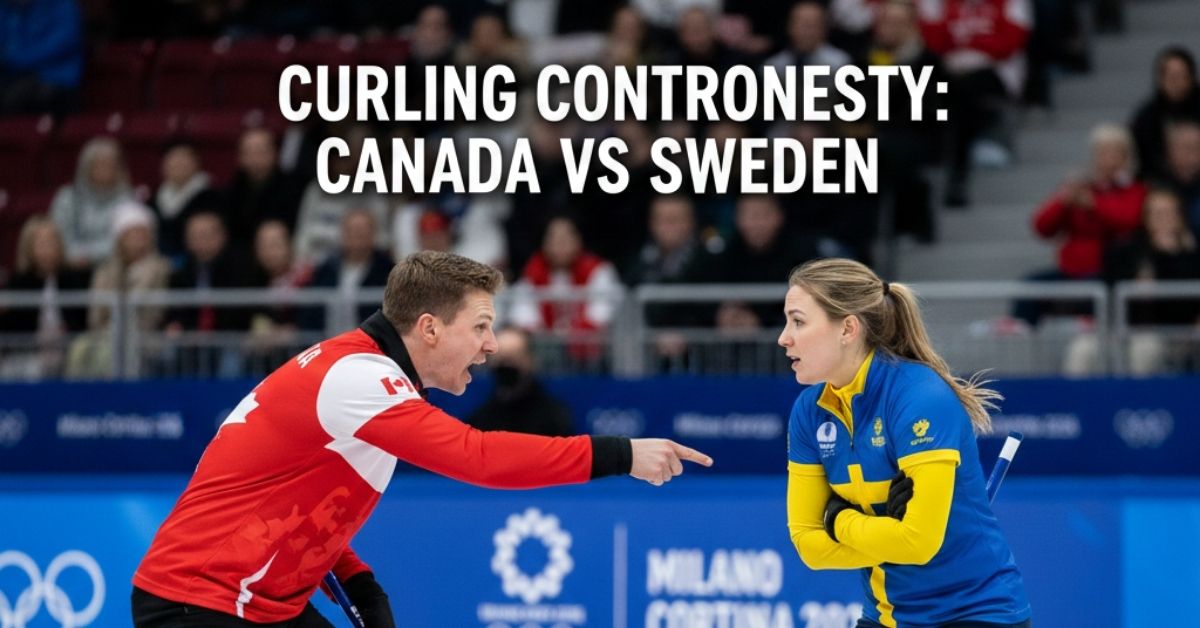
CORTINA D’AMPEZZO, Italy — The normally reserved and genteel sport of curling was rocked by a profanity-laced firestorm Friday as Team Canada defeated Sweden 8-6 in a round-robin match that quickly devolved into accusations of cheating and heated verbal exchanges heard around the world .
What should have been a straightforward victory for Brad Jacobs’ Canadian rink turned into one of the most talked-about moments of the Milano Cortina 2026 Winter Olympics, as Swedish vice Oskar Eriksson accused his Canadian counterpart Marc Kennedy of illegally double-touching the stone after the hog line .
The incident that ignited the ice
The trouble began early in the contest at the Cortina Curling Olympic Stadium, when Sweden formally raised concerns with officials that Canadian players were making contact with the stone beyond the permitted point of release. The hog line represents the critical threshold in curling where a player must release the stone—any contact beyond that line constitutes a violation .
World Curling has introduced sophisticated electronic handles on all stones at these Games, equipped with touch sensors that interact with magnetic strips embedded in the ice. These devices flash red immediately if a player maintains contact past the hog line .
However, Eriksson alleged that Kennedy was touching the actual stone itself rather than the electronic handle—a distinction that would bypass the sensor system entirely while still technically violating the rules .
The situation reached its boiling point after the ninth end. As players cleared the house, Eriksson made his feelings known, telling Kennedy he would show him video evidence of repeated infractions. Kennedy’s response was immediate and unfiltered.
“I haven’t done it once,” Kennedy shouted across the sheet, his words captured clearly by player microphones. “You can f— off” .
‘Don’t chirp’: The verbal volley that captivated viewers
The exchange, broadcast live on Eurosport and quickly circulating across social media platforms, offered viewers an unprecedented glimpse into the raw emotions simmering beneath the sport’s polite exterior.
According to reports from the Toronto Star, the confrontation included Eriksson declaring, “Apparently it’s OK touching the rock after the hog line,” followed by a chorus of Canadian responses including “who?”, “I haven’t done it once,” and the now-famous “Don’t chirp” .
Canadian lead Ben Hebert also became involved, asking officials to monitor Sweden’s deliveries with equal scrutiny—a tit-for-tat request that underscored the frosty atmosphere enveloping the sheet .
Swedish skip Niklas Edin, the most decorated curler in World Curling Federation history with three Olympic medals, expressed disappointment at his opponents’ reaction.
“In my opinion it’s kind of pretty clear what’s happening out there,” Edin told reporters after the match. “Why they start screaming about it I’m not really sure. It’s a little sad they start screaming instead of just taking it and doing better. We have no reason to lie about it. All these games are video filmed and there are quite a few cameras out there. If they say they touched it they probably did” .
Kennedy fires back: ‘I don’t like being accused of cheating’
Following the match, Kennedy made no apologies for his passionate response, defending his 25-year career and Olympic legacy that includes gold at Vancouver 2010 and bronze at Beijing 2022 .
“I have a ton of respect for Oskar Eriksson,” Kennedy said. “He’s one of the best players to ever play. I just told him … I would never accuse you of cheating. I’ve been on tour for 25 years. He pulled a hog line official on us to make sure we weren’t double-touching. The hog line official was there for six ends, never said a thing, and he’s still talking about it in the ninth end” .
Kennedy didn’t mince words when describing his feelings about the cheating accusations.
“There’s hog line devices on there. I don’t know. And he’s still accusing us of cheating. I didn’t like it. So I told him where to stick it,” Kennedy said, according to Reuters. “Because we’re the wrong team to do that to. So I don’t care” .
He later added: “I’m not going to apologize for defending ourselves against a cheating accusation. It is what it is. So onward. It’s a good game. Big win. On to tomorrow” .
World Curling investigation clears Canada
In the aftermath of the controversy, World Curling officials conducted a thorough review of the incident and the specific deliveries in question.
In an official statement, World Curling confirmed that umpires had been positioned at the hog line to monitor deliveries for three ends after Sweden first raised the issue during the game. The conclusion was definitive: “There were no hog line violations or retouches of the stone during the observation” .
However, the Swedes maintained that officials initially misunderstood the rules. According to Eriksson, when the matter was first brought to their attention, umpires incorrectly believed that “double-touching any part of the rock is OK” before later recognizing that “you can only touch the electronic part of the handle” .
This nuance—the distinction between touching the electronic handle versus the stone itself—lies at the heart of the controversy. Sweden maintains that Kennedy was contacting the granite, which would not trigger the electronic sensors but remains prohibited under World Curling regulations .
Game within the game: Jacobs continues mastery over Edin
Amidst the controversy, the actual curling match produced remarkable drama of its own. Brad Jacobs continued his historic dominance over Niklas Edin, improving his head-to-head record against the Swedish legend to 26-15 .
The pivotal moment arrived in the eighth end, when Jacobs scored a crushing four points after Edin failed to execute a double takeout, leaving Jacobs an open draw for the deuce . Jacobs finished the game with an impressive 91 per cent shooting percentage, while Edin struggled at just 70 per cent .
“Feels great, feels great,” Jacobs said of the victory. “Another must win game against Sweden. To knock them back to 0-3 is big for the spiel. They can be very dangerous and lethal, especially at the end of the week, so big win for us” .
Despite the on-ice hostilities, Jacobs emphasized that the rivalry remains respectful off the ice. “If those guys wanted to go have a beer right now, we would,” he said. “100 per cent” .
What the rules actually say
For spectators trying to understand the controversy, the relevant World Curling regulations are specific:
A stone must be clearly released from the hand before it reaches the hog line at the delivery end. If the player fails to do so, the stone is immediately removed from play .
If a moving stone is touched by its own deliverer a second time before reaching the hog line, there is no violation. However, once a stone touches the hog line, any additional contact by the delivering team constitutes an infraction .
In cases where an infraction occurs, the opposing team may choose to remove the touched stone from play and replace affected stones, or place all stones where they reasonably believe they would have come to rest .
The new electronic handles introduced for these Games were designed to eliminate ambiguity, but the Sweden-Canada incident reveals that human interpretation—and the distinction between handle and stone—remains a potential flashpoint .
Social media erupts: ‘Incredibly bad look for Canada’
As news of the controversy spread, social media platforms buzzed with reaction from curling fans worldwide. Reddit threads dedicated to the incident drew hundreds of comments, with opinions sharply divided.
“Sweden vs Canada. Sweden accuses Canada of touching the stone during curl. Judge says that yes, he saw it, but seemingly does nothing about it. A Canadian player then accuses Sweden of cheating in the same way,” one user posted in an Olympic thread .
Another commenter suggested the incident represented “such an incredibly bad look for Canada,” adding: “Not only did they break the rules, they didn’t call it dead like the integrity of the sport calls for AND they went up and tried to accuse the other team of cheating in response to them validly calling out that Canada burned their stone” .
However, Canadian supporters rallied behind Kennedy’s passionate defence, noting the immense pressure of Olympic competition and the veteran’s unblemished 25-year career.
What happens next: Standings and schedule
The victory improved Team Canada’s record to 3-0, placing them in a first-place tie with Switzerland atop the men’s curling standings . Meanwhile, defending gold medallists Sweden find themselves in an unexpected 0-3 hole, their Olympic title defence hanging by a thread .
Both teams return to action Saturday, February 14. Canada faces Switzerland at 8:05 a.m. ET in what shapes up as a battle for sole possession of first place. Sweden takes on China at the same time, desperately seeking their first victory of the tournament .
The round-robin continues through next week, with the top four teams advancing to the semifinals. Each nation plays nine preliminary matches before medal contention begins .
For Canadian curling fans wondering about upcoming events, this controversy has injected new intensity into what was already shaping up as a compelling Olympic tournament. Tickets for remaining round-robin sessions and medal rounds remain available through official channels, though availability fluctuates as the Games progress.
The bigger picture: Curling’s changing face
This incident represents something of a watershed moment for curling, a sport that prides itself on the “Spirit of Curling”—a formal code of conduct emphasizing honour, sportsmanship, and grace.
The fact that two veteran teams with decades of combined experience and genuine mutual respect found themselves embroiled in such a public confrontation suggests something about the intense pressures of Olympic competition. When national pride and gold medals hang in the balance, even the most decorous athletes can find their emotions bubbling over.
Kennedy himself acknowledged this reality when reflecting on the incident.
“It’s sport, it happens,” he said. “Think of what happens and gets said out on the ice in hockey games. It’s OK. It’s just a little bit of a heated game, and we defended ourselves” .
For Canadian audiences following the action from living rooms in Toronto, Vancouver, Montreal, Calgary, and beyond, the controversy has transformed a routine round-robin match into must-see television. The question now is whether these two teams might meet again in the medal round—and if so, whether the ice will have finally thawed.